
Are White Americans Mistaking the Cage for the World?

There is a difference between not knowing and not being able to see. This is about the second one.
Right now, in the United States, people are being held in facilities that human rights investigators have described as overcrowded, degrading, and bearing the hallmarks of what historians call concentration camps. People are dying in those facilities. Children have been separated from their parents. And the majority of white America is watching this happen and feeling, at most, mildly uncomfortable.
I want to be precise: this is not a political statement. This is a psychological one.
Because the question that should stop all of us cold is not how did this happen — we know how it happened. The question is: what has to be true about a person's interior world for them to watch human beings suffer and not experience it as a moral emergency?
That capacity does not come naturally. It has to be installed. And in white America, it was. Deliberately. Over four hundred years. Through interlocking mechanisms designed to suppress the most basic human instinct: the recognition of shared humanity.
Cage for the World: Mechanism Nobody Named in Your History Class
Most Americans learned about slavery as an economic system. A few learned about it as a legal one. Almost no one learned about what it required psychologically — not just from the enslaved, but from the people who watched.
You cannot participate in the dehumanization of another group of people without first having something broken in yourself. The capacity to stand in front of another person's suffering and feel nothing — or to feel that it is justified, or to feel that the people asking you to care are the real threat — that capacity requires engineering.
Here is what that engineering looked like.
The Cage for the World: Three Mechanisms
1. Theology: God Authorized the Cruelty
The so-called Curse of Ham was used for centuries to give the enslavement of African people the authority of scripture. The civilizing mission framed European conquest and African enslavement as spiritual gifts to inferior peoples — unprecedented violence cast as Christian charity.

When you believe your cruelty is God's will, you do not experience it as cruelty. You experience it as righteousness. The theological mechanism did not just justify racial hierarchy. It cauterized the conscience.
2. Law and Science: The System Certified It
The Three-Fifths Compromise encoded into the founding document of this nation the legal position that Black people were not fully persons. Black Codes and Jim Crow criminalized Black existence. And race science — phrenology, intelligence testing designed to confirm Black inferiority — gave white Americans what theology had given them, but with laboratory credentials.
Together, law and science told white Americans: you are not doing anything wrong. Your conscience can rest.
3. Culture: Dehumanization as Entertainment
Minstrelsy — the dominant form of American popular entertainment through most of the 19th and early 20th centuries — installed a template of Black dehumanization at the level of reflex. Birth of a Nation, screened at the White House in 1915, depicted Black men as savage predators and the Ku Klux Klan as heroes. It sparked a Klan resurgence that reached millions in membership. It was not fringe. It was the highest-celebrated American cinema of its era.
And then there was lynching.

Between 1877 and 1950, more than four thousand Black people were lynched in the American South. These were public events. Photographed. Made into postcards. Newspapers announced them in advance. People brought their children.
What does it take to bring your child to watch a human being tortured and killed? It requires the complete suppression of the capacity to recognize another person's suffering as suffering. A humanity so thoroughly conditioned that it can stand in front of death and feel nothing but pleasure and belonging.
This is not a description of monsters. This is a description of what conditioning does to people over generations.
This Conditioning Did Not End. It Evolved.
The formal structures changed — slavery ended, legal segregation ended. But the psychological architecture that made those systems possible did not dismantle itself. It adapted. It found new targets, new justifications, new language.

The same mechanisms are operating in 2026: The displacement of responsibility — I did not create this policy. I did not vote for it. The diffusion — The whole society is complicit. What can one person do? The dehumanization of the target — They came here illegally. There are consequences. The mythology of law and order as inherently just — the same mythology that made the Black Codes feel reasonable to the people who lived under them.
The comfort of not knowing has been replaced by the comfort of not looking. The information is available. The images exist. But the conditioned mind has powerful tools for not allowing that information to land as what it is.
And the most powerful of those tools is the belief that the people asking you to look are the real problem.
Three Questions That Begin the Work

The internal work of recognizing your conditioning and the external work of standing against these systems are not two different things. You cannot stand clearly against something you are still inside of. Here are the three recognition questions worth sitting with:
Where did I first receive this belief?
Whatever belief is activated right now — about who deserves protection, about what is extreme, about what the law means — when did you first receive it? Because if you can locate the installation, you can begin to experience it as something that happened to you, rather than a truth about the world.
Does this belief make my body expand or contract?
Bring the belief into your body right now. Does your chest open or close? Does your breath deepen or shallow? Conditioning lives in the body. The beliefs that protect us from seeing what we do not want to see have a particular quality — they create a narrowing, a relief from the discomfort of full perception. Learn to recognize that quality.
Who benefits from me believing this?
Every belief was installed in a context. Every belief serves someone. Who benefits from sufficient numbers of white Americans believing that these systems are unfortunate but necessary? The answer is not abstract. When you can name it clearly, you begin to see your own beliefs as the political instruments they were designed to be — rather than as your own conclusions.

The Cage
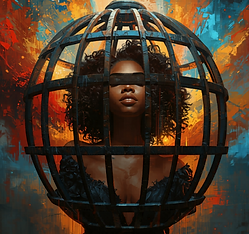
A person who has lived their entire life inside a cage, who has never been outside it, who has no memory of anything beyond its walls — to them, the cage is the world. The boundaries of their captivity feel like the natural boundaries of reality.
The mechanisms we just described built a cage around white American moral perception. Not to imprison white Americans. But to protect a system that required their moral blindness to operate.
The cage only holds the people who cannot see it. That is why recognition is the beginning of everything.
This post is drawn from The Power Prophet Live: Episode 2 — Mistaking the Cage for the World, now streaming on YouTube. The full session includes the historical record, the present-day parallels in real time, and the live recognition practice.
If this landed somewhere specific — if you recognized a belief you have never questioned, if something shifted in how you understand what you are watching in this country and why — private session work is available. Right now, new clients receive 75% off a first session with code SPRINGSURPRISE at checkout. This offer closes June 20, 2026.
Book your session at power-prophet.com

Comments