
Why Critical Thinking is the Spiritual Discernment Skill No One Teaches You

Behind the spiritual work I am known for now as Dr. Akila Ka Ma't, the Power of Release program: Recognize, Release, Reframe and the Somatic-Metaphysical Tarot™ method I developed for transformational resonance guidance sits a different kind of background. For more than two decades as academic Jennifer R. Warren (see CV below), I taught critical thinking and its application to students. As a scholar, it is the lens through which I took on research investigation, created study designs, and shared findings/interpretations through peer-reviewed publications and conference presentation.
The reason I bring this up is not to credential myself. It is to be honest about lineage.
When I write about critical thinking and spiritual discernment, I am writing from two rooms at once. The academic room I lived in for a long time. And the spiritual room I have been building throughout my life and now sit in as my vocation. Most of what is taught in the spiritual space about discernment is missing the rigor. Most of what is taught in the academic space about critical thinking is missing the soul. The work I do now is the bridge between those rooms.

What Critical Thinking Actually Is and What It Isn't
Most people, when they hear the phrase critical thinking, picture something cold. Skeptical. A little hostile to spirituality. That is not what critical thinking is.
Critical thinking is the practice of examining beliefs, assumptions, sources, and patterns before accepting them as true. It is the disciplined habit of asking, Where did this come from? Who taught me this? Does it hold up when I test it against my own experience? Whose voice am I hearing when I think this thought?
In spiritual development, critical thinking goes by another name. Discernment.
Critical thinking is the discernment skill that lets you separate inner guidance from inherited conditioning. Without it, awakening repeats old patterns in new language. With it, your spiritual journey becomes your own.
Now let me name what critical thinking is not, because the wrong definitions are everywhere.
It is not cynicism. Cynicism assumes everything is false. Critical thinking asks is this true and stays present for the answer.
It is not contrarianism. Contrarianism opposes for the sake of opposing. Critical thinking examines for the sake of clarity.
It is not overthinking. Overthinking is anxiety wearing a thinking costume. Critical thinking has a rhythm, and it knows when to stop.
It is not intellectual defense. Building an airtight argument to protect your identity is not thinking critically. It is protecting the ego with sophistication.
The version of critical thinking I am offering you here is the partner of intuition, not its opponent.
What Spiritual Discernment Really Means

Spiritual discernment is the cultivated ability to tell what is true for you from what has been absorbed, inherited, or installed.
Notice the word cultivated. Discernment is not something you wake up with. It is something you build. Most seekers come to spirituality hoping that awakening will deliver discernment as a kind of bonus. It does not. Awakening hands you a sharper inner life and asks you to do the work of telling truth from echo.
Real discernment has three parts. Most teachings only address one.
The body carries a piece of discernment. The body knows before the mind catches up. Tightness, openness, the held breath, the easy exhale. These are signals. Somatic awareness is one third of the work.
Intuition carries a piece. Intuition is the subtle information that arrives in image, in knowing, in a quiet certainty that does not pressure you. Intuitive recognition is another third.
The mind carries the last piece, and this is the piece nobody is teaching. The mind, sharpened through critical thinking, is what allows you to ask whether the signal is fresh information or a familiar echo. The mind is what closes the circle.
I call the full practice Recognition Radar. Body. Intuition. Mind. Working together in service of release.
Why Almost No One Teaches Critical Thinking to Spiritual Seekers
If critical thinking is this important — for awakening, for discernment, for release — why has almost no one taught you?

I have been asking that question for a long time, and I want to give you the honest answer.
Schools teach memorization, not examination. Most religious traditions teach compliance, not questioning. Many spiritual communities reward belief, not discernment. Mainstream culture rewards performance over reflection. And the algorithm in your pocket is built to give you more of what you already believe, not to question it.

There is a deeper reason underneath all of this. Critical thinkers are harder to control.
They are harder to sell to. They are harder to shame into compliance. A person who has built the discernment muscle cannot be kept inside the pattern I call the Scarcity-Pain Matrix of Fear as easily as a person who has not.
The Scarcity-Pain Matrix of Fear is the 3D conditioning environment where unresolved pain and learned scarcity quietly organize your identity, purpose, emotions, and patterns. It does not need to lock you up. It only needs you to stop asking questions.
That is why critical thinking was never installed alongside your spiritual education. It is the one skill that interrupts the Matrix at the root.
How to Begin Building Critical Thinking and Spiritual Discernment
You do not build this muscle by working on every belief at once. You build it by working on one. Then another. Then another. The reason most people never develop discernment is that they try to think their whole life at once and give up before they have looked at anything fully.
Start small. Start with one.
I opened the first stream of the series with the reflective exercise Unexamined Belief.
Sit somewhere quiet. Take five slow breaths, with the exhale slightly longer than the inhale. That alone settles the body enough that you can observe instead of react.
Then finish whichever of these sentences arrives first. Do not edit it. Do not soften it. Do not spiritualize it.
I am not _______ enough.
I always _______.
People like me don't _______.
Whatever came first, write it down exactly as it arrived. Then sit with four questions, one at a time, with space between each.
When is the first time I can remember believing this about myself?
Whose voice do I hear when I think this thought?
Who benefits when I keep believing this?
What evidence have I gathered to confirm this, and what evidence have I quietly ignored?
Look at what is on your page when you are done. That belief has been organizing your life. It has shaped what you have chased, what you have avoided, what you have performed, what you have protected. And until this moment, you were inside it. Now you are looking at it.
That is critical thinking. That is the beginning of spiritual discernment.
Why This Skill Changes Everything About Your Spiritual Journey
When you can examine a belief without being inside it, the belief stops running you. That is the heart of what critical thinking gives a spiritual life.
Three things tend to shift, often within weeks of consistent practice.

Your intuition gets clearer. Not louder. Clearer. The noise of conditioning quiets when it is examined, and what is left underneath is the signal you have been trying to hear all along.
Your patterns become visible. Loops that used to run automatically slow down enough that you can see their shape. Once you can see the shape, you stop confusing it for guidance.
Your spiritual journey starts feeling like yours. Not like a role you are performing for an inner audience. Not like a script you inherited. Yours.
There is one more shift that takes longer but matters more. The symptoms of incongruence, such as the anxiety that will not quit, the depression that returns in cycles, the same relational story playing out in different costumes, these often soften. Because mental health and behavioral patterns are very often symptoms of the gap between what you authentically feel and what you have been conditioned to perform.
Critical thinking closes that gap. Not by force. By recognition.
Your Invitation:

The Critical Thinking Awakening — A Free 3-Part Livestream Series
If this piece has reached something in you, the next step is already here.
This Friday I began a three-part definitive livestream series called The Critical Thinking Awakening. It is for every seeker who is ready to make their spiritual journey their own. The work is real. The practices are practical. Each stream is sixty minutes. The bonus is each stream comes with a free companion guide available at the start of the livestream for reflective practice during the episode: The Discerning Mind for Pt. 1 is linked below. The Pattern Map for Pt. 2. The Sovereign Seeker for Pt. 3. Together, the episode and guide form the cognitive third of practices and tools applied in Recognition Radar Sessions, an essential phase that makes the rest of the Power of Release program actually work.

Pt. 1 — Friday, May 15: Why Most Spiritual People Cannot Actually Think. The foundational work. We named what critical thinking is, why almost no one has been taught it, and you will do the Unexamined Belief practice live with me. Access The Discerning Mind Companion Guide.

Pt. 2 — Monday, May 18: Mistaking Conditioning for Intuition. The trap. We will trace how spiritual bypass hides inside language like trust the universe and I don't want to be negative, and you will map one repeating loop in your life live with me.
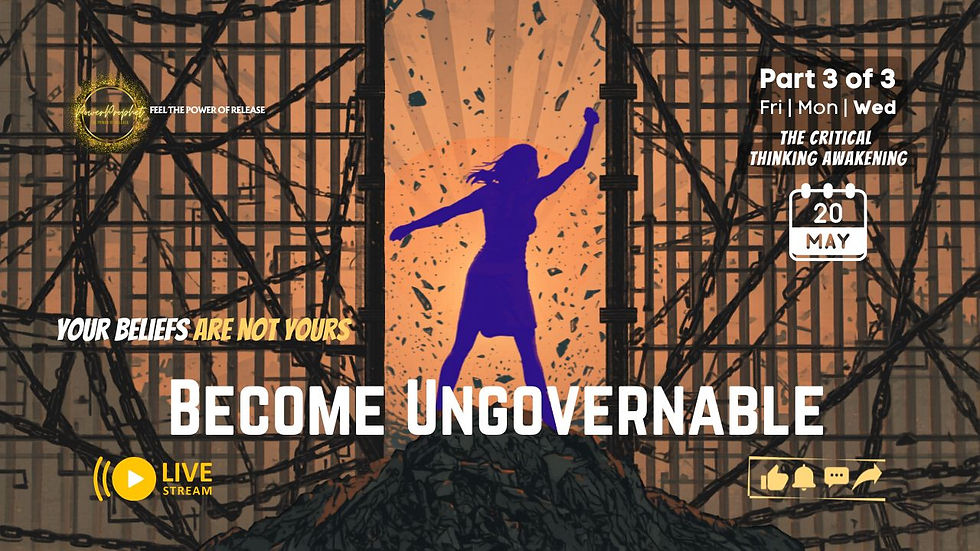
Pt. 3 — Wednesday, May 20: Become Ungovernable:The Self-Sovereign Toolkit. The daily practice. We will move through the five moves that build sovereignty into the texture of an ordinary day, and you will run a live Sovereignty Check.
What to Bring
A journal. Honesty. The willingness to look.
That is all.
A Closing Word
Recognition is not failure. It is evidence that consciousness is coming online. It signals that something in you is awake enough to begin seeing what was already there. You do not have to shame the belief to outgrow it. You do have to see it truthfully.
Critical thinking is not the opposite of your spiritual development. It is the discernment muscle that makes your spiritual development real instead of performative. And it is the gateway skill that lets the rest of the work hold.
I will see you Monday, May 18 at 11:00 am.
Feel the Power of Release.
Frequently Asked Questions

Is critical thinking the same as spiritual discernment? Closely related, but not identical. Critical thinking is the cognitive practice of examining beliefs, assumptions, and patterns before accepting them as true. Spiritual discernment is the lived application of that practice across body, intuition, and mind together. Critical thinking is one essential ingredient of spiritual discernment.
Can critical thinking hurt my spiritual practice? No, but used as intellectual defense it can mimic discernment without producing it. The difference is whether the thinking stays open and curious or hardens into argument. Real critical thinking softens you toward truth. Intellectual defense closes you off from it.
Where do I start if I have never been taught critical thinking? With one belief. Use the Unexamined Belief practice in this post. Trace one belief about yourself through the four questions. Then carry one daily question with you — Does this belief open me up, or does it restrict me? That is enough to begin.

About the Author
Dr. Akila Ka Ma'at is founder of Power Prophet. As a 30 year psychic advisor and practicing metaphysical guide, she holds a PhD in Communication Social Science with expertise grounded in more than 20 years of identity expression and health research and dozens of peer-reviewed scientific publications.
Leaving a successful academic career, Dr. Ma'at shares the hardships of that experience in Ivory Tower Hypocrisy. There she reveals why scarcity, pain, and identity must be seen as deeply embedded in the formation of selfhood, relationships, and life direction. That intellectual and personal grounding shapes the Scarcity-Pain Matrix and her Somatic-Metaphysical Tarot™ System, both frameworks for recognizing how emotional burdens influence selfhood, relationships, and purpose.
Her book, The Power of Release, discusses her spiritual journey to recognize, release, and reframe those burdens in the movement toward authentic identity and purpose and is the foundational text of the Power of Release program.
Book your Initial Recognition Radar session today! New clients use promo code SPRINGSURPRISE to get a 75% discount.



Comments